Field Studies
Visit our repo directly to learn your persona type
The world is currently awash in advice about how to use AI coding tools. Most of this advice is based on anecdotes and dubious metrics. Attempting to follow all of it would be impossible, and possibly financially ruinous. Clearly, we need better evidence about what leads to positive outcomes with these tools.
In this context, the new SWE-chat dataset is a goldmine: 5,825 real coding sessions, with full environment-level and session-level metadata, from 188 distinct users doing real work across 198 repositories. As of this writing, SWE-chat is the richest publicly-available resource for understanding how people are using coding tools (see their Table 1 for a comparison with other resources).
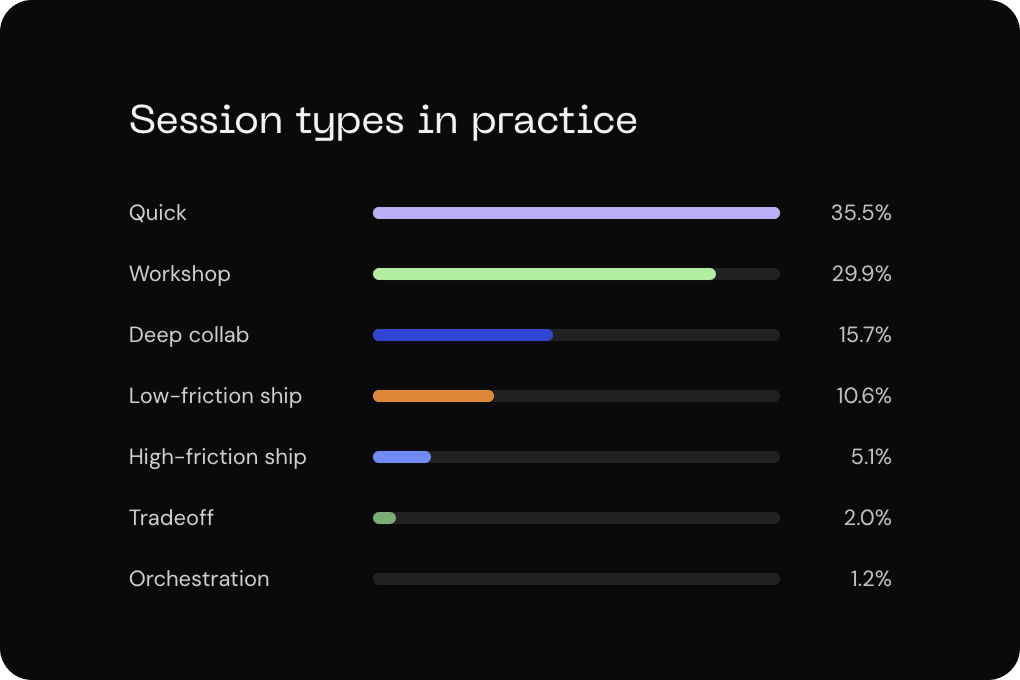
At Bigspin, we are finding that SWE-chat can yield deep insights, for users and product developers alike, about how to derive more value from AI coding. In this microsite, we provide a first report on this ongoing research. Our core contribution is to identify seven distinct session types that vary widely in their structure, orientation, and expected outcomes. Just seeing these types has already made us at Bigspin more aware of what we are trying to do in a given session and, in turn, what actions we can take to meet those goals.
We also use these session types to identify seven higher-level shapes of productive practice: The Pair Programmer, The Spec-First Architect, The Quick-Turn Sprinter, The Showrunner, The Runtime Mechanic, The Prompt Minimalist, The Multi-Mode Journeyman . These users are working with AI in very different ways to achieve very different outcomes. Once again, recognizing this as a user is enormously helpful in terms of personal growth, and product developers should try to identify and capitalize on these distinctions.